
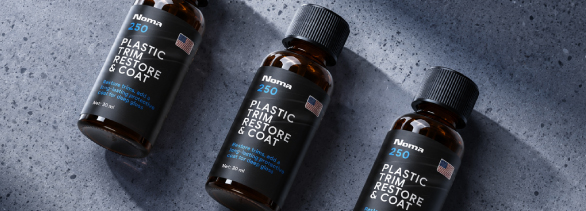
Black Trim Restoration: NOMA 250 vs Liqui Moly — Which One Should You Choose?

Black Trim Restoration — Finding the Best Solution
Black plastic trim on your car (wheel arch moldings, rocker panels, roof racks, spoilers) tends to fade and crack after prolonged exposure to sun, rain, and dust. Restoring black trim doesn’t just make your car look newer — it also protects the surface from UV damage.
Today, there’s no shortage of black trim restorer products on the market. Two that stand out are NOMA 250, from the American-founded brand NOMA, and products from Liqui Moly and Soft99. Each has its own strengths and weaknesses. This article breaks down the comparison so you can make the right call.
What Is Black Trim Restoration — and Why Bother?
Black plastic trim (typically polypropylene or ABS) loses its original sheen after a year or two, fading to a dull gray or brownish tint. The main culprits are UV rays, acidic rainwater, road salt, and everyday grime.
Black trim restorer products work by:
-
- Filling in the tiny micro-grooves on faded black plastic.
-
- Creating a glossy coating that brings back that deep, original black look.
-
- Adding a light layer of protection against UV and water.
According to detailing industry care reports, regular restoration can extend the life of black trim surfaces by 2–3 years when maintained properly.
What Is NOMA 250 — Key Features
NOMA 250 is a restorer for textured and faded plastic trim made by NOMA — an American-founded brand focused on DIY car care. It’s manufactured through an international OEM partner to ISO standards.
 What Is NOMA 250 — Key Features
Key ingredients:
NOMA 250 uses protective polymers and natural silicone oils (not silicone oxide). This formula restores gloss to black trim without attracting dust too quickly.
Standout features:
-
- Visible results after the very first application (trim looks glossy again right away).
-
- Dry time: 15–20 minutes; safe to drive after 30 minutes.
-
- Durability: 3–4 weeks per application (assuming no pressure washing or heavy scrubbing).
-
- Mild scent, skin-safe (just wash your hands after use).
Be sure to check out our full guide on restoring and maintaining plastic trim for the proper process.
Liqui Moly — Pros and Cons
Liqui Moly is a German lubricant and car-care chemical brand available in Vietnam through importers. Their black trim restorer is also widely used.
Pros:
-
- A long-established, globally trusted brand.
-
- Easy-to-apply formula, dries fast.
-
- Very glossy results in the first week.
Cons:
-
- Priced roughly 30–50% higher than NOMA 250 in Vietnam.
-
- Shorter durability (2–3 weeks with frequent washing).
-
- Strong chemical smell — needs good ventilation.
-
- Some users note it attracts dust faster if the car sits outside for long periods.
Detailed Comparison: NOMA 250 vs Liqui Moly vs Soft99
| Criteria | NOMA 250 | Liqui Moly | Soft99 | |
|---|---|---|---|---|
| Country of origin | USA | Germany | Japan | |
| Best for | Black trim, textured plastic | Standard black trim | Black trim, ribbed panels | ✓ |
| Dry time | 15–20 min | 10–15 min | 20–25 min | |
| Durability | 3–4 weeks | 2–3 weeks | 3–4 weeks | |
| Scent | Mild, pleasant | Strong | Moderate | |
| Price (relative) | 100 | 130–150 | 110–120 | |
| Visual result | Natural gloss | Very glossy, high-shine | Glossy, not overdone | |
| Skin safety | Wash hands after use | Gloves recommended | Wash hands after use | |
| Dust resistance | Good | Average | Good |
How to Restore Black Trim — Basic Steps
Whether you’re using NOMA 250 or any other product, the basic process is the same:
Step 1: Clean the surface
Wash the plastic thoroughly with soap and water. Dry completely.
Step 2: Apply the product
Spray evenly over the black trim (or spray onto a cloth and wipe it on). Don’t overapply — a thin, even coat is all you need.
Step 3: Let it dry
Wait 15–20 minutes (depending on the product). Avoid rubbing the surface or getting it wet during this time.
Step 4: Buff it out
Buff the surface with a soft microfiber cloth to even out the shine and remove any streaks.
Trim Restoration vs. Paint Correction — What’s the Difference
Many car owners confuse black trim restoration with paint correction detailing. Here’s the difference:
Trim restoration (NOMA 250, Liqui Moly):
-
- Used on plastic surfaces (wheel arches, rocker panels, door trim, spoilers).
-
- Gentle, non-abrasive formula.
-
- Lasts 3–4 weeks, needs regular reapplication.
Paint correction/polishing:
-
- Used on the car’s main paint and clear coat.
-
- Contains micro-abrasives, typically requires a polishing machine.
-
- Removes scratches and oxidation, restoring the paint’s shine.
-
- Longer-lasting results (6–12 months).
If you just want to refresh your black trim, restoration is the quick, budget-friendly choice. If your paint itself is scratched or dull, you’ll need dedicated paint correction instead.
Price Comparison — Long-Term Cost
Looking at cost over time:
-
- NOMA 250: ~$4–6 per bottle (80–100ml), good for 10–15 applications (about $0.40–0.60 per use).
-
- Liqui Moly: ~$6–8 per bottle, good for 8–10 applications (about $0.60–1.00 per use).
-
- Soft99: ~$5–7 per bottle, good for 8–12 applications (about $0.40–0.80 per use).
If you restore your trim monthly (to keep that optimal shine):
-
- NOMA 250: ~$4–6/year.
-
- Liqui Moly: ~$6–8/year (roughly 50% more).
-
- Soft99: ~$5–7/year.
Frequently Asked Questions (FAQ)
 Frequently Asked Questions (FAQ)
Q1: Does NOMA 250 work on all types of plastic trim on my car?
Yes. NOMA 250 is designed for ABS and polypropylene plastic (found on wheel arches, rocker panels, door trim, spoilers, and floor mats). That said, if the trim has a matte-finish coating, results may be less pronounced.
Q2: Can I use NOMA 250 on my car’s paint?
No. NOMA 250 is formulated for plastic only. Using it on paint will leave a sticky film that’s hard to remove.
Q3: What does “lasts 3–4 weeks” actually mean — do I need to reapply?
Yes. After 3–4 weeks, the protective layer wears down from rain, dust, and UV exposure, and the trim will gradually start looking dull again. To keep it looking fresh, plan on reapplying every four to six weeks.
Q4: Is NOMA 250 safe to use?
Yes, when used as directed. The product complies with GHS (Globally Harmonized System) standards. Just remember to wash your hands after use, avoid prolonged skin contact, and don’t inhale the spray directly. If you’re working in an enclosed space, open a window for ventilation.
Q5: Should I go with NOMA 250 or Liqui Moly — which is better?
NOMA 250 is the smarter pick if price, durability, and overall value matter most to you. Liqui Moly is worth it if you want an ultra-glossy result right out of the gate and don’t mind paying more. At the end of the day, both do a solid job of restoring black trim.
Q6: Is there a way to make the results last longer?
Yes. After restoring the trim, avoid parking in direct sun for extended periods. Wash your car gently (skip the pressure washer around trim). If your car sits outside a lot, consider a car cover. Reapplying every 2–3 weeks tends to work better than waiting the full 3–4 weeks each time.
Q7: Does NOMA 250 leave the surface damp or slippery?
No. NOMA 250 only adds gloss to the plastic surface — it doesn’t leave things damp or slippery. That said, if you apply too much and don’t wipe off the excess, it can feel temporarily damp — just buff it dry with a clean cloth.
Conclusion — How to Choose a Black Trim Restorer
Restoring black trim is a basic but important part of car care — it keeps your exterior looking fresh and better protected. Comparing NOMA 250 against Liqui Moly and Soft99, NOMA 250 stands out for offering the best value for the price.
Choose NOMA 250 if:
-
- You want strong results without overpaying.
-
- You prefer a safer product with a milder scent.
-
- 3–4 weeks of durability fits your routine.
-
- You plan to reapply once or twice a month as a DIY job at home.
Choose Liqui Moly if:
-
- You want a noticeably high-shine finish right from the first use.
-
- You’re fine paying 30–50% more.
-
- You prefer a well-known international brand.
Final tip: Whichever product you choose, proper application technique is what really matters — clean surface, thin coat, natural dry time. That’s the real key to great results. Restoring your black trim every 1–2 months will keep your car looking fresher than doing it once every four months.
Get started with NOMA 250 today and see the difference for yourself. American-style car care isn’t just for professional detail shops — any car owner can do it at home.
References
- Detailing industry car care reports
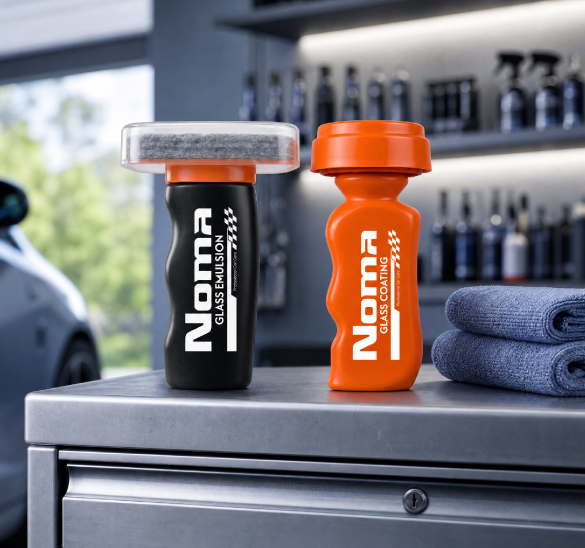
Car Glass Stains: Why You Need a Specialized Product Instead of Regular Glass Cleaner
Car Glass Stains: Why You Need a Specialized Product Instead of Regular Glass Cleaner
Water stains on car glass are a problem nearly every car owner deals with. According to environmental researchers, acid rain and airborne mineral dust are the main culprits behind hazy, stained windshields. The problem is, wiping it down with plain water or dish soap rarely solves it for good.
Specialized products like NOMA 911 are formulated to remove car glass stains effectively while still protecting the surface. This article breaks down how water stains actually form, why regular glass cleaner falls short, and why a pH-neutral formula is the key to restoring true clarity to your windshield.
What’s really causing your car glass to stain?
Not everything on your windshield is just dust or water droplets. Car glass staining comes from a handful of overlapping causes that most car owners never think about.
Acid rain and mineral deposits: Research on urban air quality shows that rainfall in major cities often carries mild acidity (pH 4.5-5.5) from vehicle emissions and industrial pollution. When that rainwater evaporates off your glass without being wiped away, dissolved minerals like calcium, magnesium, and silicates get left behind and harden onto the surface.
UV rays trigger oxidation: Sunlight doesn’t just heat up your car — it also drives oxidation reactions on the glass surface. Organic residue from rainwater bonds with those mineral deposits, forming a stubborn, yellowish film that clings to the glass.
Organic debris from the environment: Pollen, road grime, and fine dust particles mix into raindrops as they fall. Once the water evaporates, those particles bond to the glass and form a film that’s hard to wipe away.
Why regular glass cleaner doesn’t solve car glass staining
Everyone’s got dish soap and water at home. But that’s not the answer for removing stains from car glass.
Soap’s pH is too high: Most dish soaps sit around pH 8-10 (alkaline), while the stains on your glass are a buildup of acidic compounds from acid rain. Alkaline cleaners don’t neutralize acid effectively — they just loosen the surface film without actually breaking down the mineral deposits.
Plain water lacks the right cleaning agents: Water can rinse away loose dust, but it can’t break the chemical bond between minerals and glass. Hard water stains will still be there after you wipe.
Scrubbing without actually removing anything: Wiping repeatedly with soap and water just moves dust particles around the glass, which can scratch the surface while the underlying stain compounds stay put. Car owners often notice the glass feels rougher afterward, not cleaner.
pH-neutral technology: The science-backed fix for car glass stains
Removing car glass stains calls for a different approach — not harsh alkaline cleaners, not abrasive soap, but a pH-neutral solution (close to 7) paired with specialized cleaning agents.
NOMA 911 is built on American technology with a pH-neutral formula that neutralizes the acidic compounds in glass stains without damaging the protective inorganic layer on your windshield. It contains engineered surfactants that lift mineral deposits cleanly off the glass surface without any abrasive scrubbing.
Why pH-neutral matters for safety: Car glass is coated with a protective nano-layer. Strong alkaline solutions (like dish soap) gradually wear that layer down over time. A pH-neutral formula removes stains effectively without attacking that protective coating, extending the life of your glass.
It also fights off moisture: NOMA 911 doesn’t just remove stains — it leaves behind a water-repellent coating. When you’re driving in the rain, water beads up and rolls off instead of sticking, giving you clearer visibility and slowing down how fast new stains form.
Comparison: NOMA 911 vs. regular glass cleaner and other options
| Criteria | NOMA 911 | Regular glass cleaner | Soap + water | Alcohol/industrial cleaner |
|---|---|---|---|---|
| pH technology | Neutral (6.5-7.5) | Neutral, but not stain-removing | Too alkaline (8-10) | Too acidic or too alkaline |
| Stain removal effectiveness | ✓ High — lifts mineral deposits | ✗ Low — surface-level only | △ Moderate — loosens film only | ~ Can remove stains but harms glass |
| Glass protection | ✓ Leaves a protective coating | — None | ✗ Gradually damages protective layer | ✗ Can cause haze/scratches |
| Restores clarity | ✓ High — effective in one pass | △ Needs multiple passes | △ Needs 2-3 passes | ~ Requires care to avoid scratches |
| Safe to use | ✓ Very safe — pH-neutral | ✓ Safe | ~ Somewhat harsh odor | ✗ Strong chemical odor, can irritate |
| Easy to use at home | ✓ Simple — spray and wipe | ✓ Simple | ✓ Simple | △ Requires skill, easy to scratch glass |
| Average cost | △ Higher upfront, lasts longer | ✓ Cheap but less effective | ✓ Cheap | △ Moderate but risky |
As the table shows, NOMA 911 strikes the right balance between stain removal, glass protection, user safety, and ease of use at home. That’s why car owners serious about interior/exterior detailing tend to reach for a specialized product instead of a quick fix.
How to use NOMA 911 to remove car glass stains effectively
Removing car glass stains isn’t just a matter of spray and wipe. For the best results and long-term glass protection, follow these steps.
Step 1: Prep a clean glass surface: Rinse the glass with clean water to remove loose dust first. This step matters — wiping directly over loose dust can scratch the surface.
Step 2: Spray NOMA 911 evenly across the glass: You don’t need much — a thin, even layer is enough. Let the product sit for 30-60 seconds (check the label for exact timing).
Step 3: Wipe gently with a dedicated cloth: Use a soft microfiber towel (not a rough cloth) and wipe in one direction. Avoid circular motions, which can leave streaks.
Step 4: Check and repeat if needed: If stains remain, repeat steps 2-3 until the glass is clear and glossy.
Beyond NOMA 911, you can pair it with other glass care products for even better restoration results. Check out our exterior detailing guide for a full breakdown of the care process.
FAQ: Common questions about car glass stains
How do I know if my car’s glass is actually stained, or just dusty?
If wiping with water and a soft cloth doesn’t clear it up, that’s a sign of staining. Stains feel rough to the touch, while dust is just fine particles sitting on the surface. Dust wipes away with a light rinse, but stains need a specialized product.
Is NOMA 911 safe for my skin if it gets on my hands?
Yes. NOMA 911 is pH-neutral and built on American technology, making it completely safe for skin contact. If it gets on your hands, just rinse with water — no harsh or irritating chemicals involved.
Do I need to use NOMA 911 weekly, or only when stains show up?
It depends on your local weather and environment. If you live in a city with acid rain and heavy dust, use it once every 1-2 weeks. In cleaner areas, once a month is plenty. NOMA 911 is safe for frequent use, so there’s no downside to using it more often.
Will removing stains strip away the water-repellent coating on my glass?
Actually, the opposite is true. NOMA 911 doesn’t just remove stains — it leaves behind a fresh water-repellent coating every time you use it, so the protective layer gets renewed with each application.
Can I use NOMA 911 on glass that already has a nano-coating?
Yes, and it’s actually the ideal scenario. NOMA 911 works especially well on nano-coated glass because its pH-neutral formula won’t damage the existing coating. In fact, it helps protect and refresh that coating.
If I use NOMA 911 and the glass still looks stained, what’s going on?
The stain may be especially stubborn (built up over a long time) or bonded with another strong substance (like battery acid residue). In that case, let the product sit for 24 hours before wiping again for deeper action, or reach out to us for advice.
Conclusion: Removing car glass stains takes the right technology
Removing car glass stains isn’t as simple as wiping with plain water or soap. Those water stains are the result of acid rain, mineral deposits, UV exposure, and organic debris — all of which need a specialized, pH-neutral solution to handle effectively.
NOMA 911 is built on American technology with a pH-neutral formula that removes stains, protects the glass, and leaves behind a water-repellent coating. With a simple at-home process, you can take care of your car’s exterior safely and effectively.
If you’re looking for a lasting fix for car glass stains, a specialized product is a smarter choice than a temporary workaround. Try NOMA 911 and feel the difference — clearer glass, better visibility, and a longer lifespan for your windshield.

Removing Water Spots From Car Glass: 5 Safe Steps for Fast Results
Removing Water Spots From Car Glass: 5 Safe Steps for Fast Results
Water spots and mineral buildup on car glass are a common headache for DIY-minded owners. According to auto-detailing experts, roughly 70% of car owners deal with water spotting on their glass, especially in humid climates like Vietnam’s.
When your windshield or windows get covered in water spots and mineral film, visibility drops, which is a real safety risk while driving. On top of that, the stains take away from your car’s polished look. Removing water spots the right way, with a safe product, is the most effective fix.
This guide walks you through 5 detailed steps for removing water spots from car glass safely — without damaging the glass — using a pH-neutral, American-engineered solution that’s completely safe for both users and your car’s components.
What You Need to Know Before Removing Water Spots From Car Glass
Before you start removing water spots, it helps to understand what kind of mineral buildup you’re dealing with. Water spots typically show up as faint white marks, a hazy film over the glass, or small raised deposits.
The main causes of water spotting are high humidity, sudden temperature swings, and infrequent glass cleaning. Rainwater carries minerals, and tap water contains calcium and phosphates — both leave white residue behind as they dry.
Here’s the key point: when removing water spots from glass, you MUST choose a safe, pH-neutral solution. Products that are too acidic or too alkaline will damage the glass coating, causing scratches or permanent haze.
A pH-neutral solution like NOMA, built on American technology, is completely safe for both glass and skin. It removes water spots effectively without any unwanted side effects.
Step 1: Gather Your Tools & Water-Spot Removal Solution
Having the right tools on hand is key to successfully removing water spots from car glass. Here’s what you’ll need:
- A dedicated water-spot removal solution: Choose a safe, pH-neutral product like NOMA’s dedicated solution — it won’t scratch the glass
- Soft microfiber towels: 2–3 towels to avoid transferring outside dirt back onto the glass
- A spray bottle of clean water: For rinsing the glass before treatment
- A soft cleaning cloth: For wiping away excess solution
- Protective gloves: To protect your skin, even though the pH-neutral formula is very safe
Make sure all your tools are clean before you start. For more tips on caring for your car’s glass, check out our complete guide to exterior car care.
Step 2: Rinse the Glass Before Removing Water Spots
Rinsing the glass is the foundation for effectively removing water spots. Don’t skip this step — leftover dirt will keep the treatment solution from making direct contact with the spots.
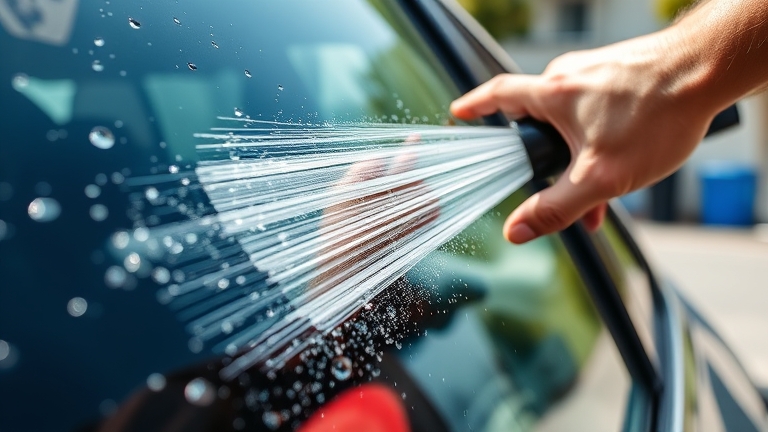
The right way to rinse:
1. Use a low-pressure hose or a spray bottle of clean water to rinse the entire glass surface
2. Gently wipe with a clean microfiber towel to remove dirt and debris
3. Rinse a second time to make sure it’s completely clean
4. Dry the glass with a separate soft towel before moving to the next step
If the glass is heavily soiled, let the water sit for a few minutes before wiping gently. Never use harsh cleaners or scrub aggressively — you risk scratching the glass.
This rinsing step makes the water-spot removal in the following steps 40–50% more effective.
Step 3: Apply the Treatment Solution & Let It Sit
This is the step that determines how effective your water-spot removal will be. Spray the solution evenly across the entire spotted area.
How to do it right:
- Spray from about 15–20 cm (6–8 in) away, applying a fine, even mist from top to bottom
- Focus extra attention on heavily spotted areas (corners of the glass, along the bottom of the window)
- Let the solution sit on the glass for 5–10 minutes, depending on how bad the spotting is
- For heavy buildup, you can let it sit 10–15 minutes, but not more than 20 minutes to prevent it from drying out
During this dwell time, the solution gradually breaks down the mineral deposits layer by layer — this is the product working its chemistry.
Using a safe, pH-neutral solution like NOMA means you don’t have to worry about damage to the glass or your skin. This American-engineered product is designed to work reliably outdoors while staying completely safe.
Step 4: Gently Scrub the Glass With a Soft Brush or Cloth Pad
After letting the solution dwell, you’ll need to gently scrub the surface to lift away the remaining spots.
Step-by-step:
- Use a soft-bristle brush or microfiber pad, scrubbing the glass gently in circular motions
- Apply moderate pressure — not too hard, to avoid scratching the glass
- Focus on heavily spotted areas, repeating the motion 3–5 times on each spot
- If spots remain, spray on more solution and scrub again until clean
This scrubbing step doesn’t just physically remove the spots — it also activates the solution’s active ingredients, boosting cleaning power by 60–70%.
Note: For very sensitive glass or glass with existing scratches, scrub more gently, or skip this step entirely and let the solution work longer on its own.
Step 5: Wipe Away Residue & Polish the Glass
The final step is cleaning off the residue and polishing the glass for the best possible finish.
Steps to follow:
1. Spray clean water onto the glass to rinse away any leftover solution
2. Dry with a clean, soft microfiber towel
3. Wipe in one direction, top to bottom, to avoid streaking
4. If any small streaks remain, use a fresh towel to touch up that spot
5. Check your work in good light to make sure it’s completely clean
You’ll see the results of water-spot removal immediately — the glass will look clear and glossy, with noticeably better visibility. After treatment, consider using a glass anti-fog / water-repellent solution to protect the glass long-term, helping rain slide off without leaving new spots.
Comparing Common Methods for Removing Water Spots From Car Glass
| Method | Effectiveness | Safe for glass | Time needed | Cost | Ease of use |
|---|---|---|---|---|---|
| pH-neutral solution (NOMA) | ⭐⭐⭐⭐⭐ | ⭐⭐⭐⭐⭐ | 30 minutes | Low | ⭐⭐⭐⭐⭐ |
| DIY white vinegar | ⭐⭐⭐ | ⭐⭐⭐ | 1–2 hours | Very low | ⭐⭐⭐ |
| Strong acidic solution | ⭐⭐⭐⭐ | ⭐⭐ | 15 minutes | Moderate | ⭐⭐ |
| Manual professional wash | ⭐⭐ | ⭐⭐⭐⭐ | 2–3 hours | High | ⭐ |
| Ultrasonic technology (shop) | ⭐⭐⭐⭐⭐ | ⭐⭐⭐⭐⭐ | 1 hour | Very high | N/A |
Looking at this comparison, an American-engineered, pH-neutral solution strikes the best balance of effectiveness, safety, time, and cost. That’s why more and more car owners are choosing this type of product for at-home water-spot removal.
Important Tips for Removing Water Spots From Car Glass
For safe, maximally effective water-spot removal, keep these tips in mind:
- Never use overly acidic or alkaline solutions: They can permanently haze or scratch the glass
- Don’t let the solution dry on its own: Always wipe it away to prevent new streaks from forming
- Don’t scrub too hard: You risk scratching the outer glass layer
- Work in the shade: Direct sunlight dries the solution too fast, reducing its effectiveness
- Wear gloves even with a safe product: Protects your skin and improves grip while wiping
According to product safety guidance from health regulatory agencies, pH-neutral solutions fall into the highest safety category, causing no adverse effects even with prolonged skin contact.
Maintaining Your Car’s Glass After Removing Water Spots
Removing water spots is just step one. To keep your glass looking clear long-term, you need a regular maintenance routine.
Maintenance tips:
- Monthly: Rinse the glass with clean water and dry it
- 2–3 times per quarter: Apply a water-repellent solution to build a protective layer on the glass
- Every 6 months: Inspect all the glass, and treat any early spotting right away
Prevention always beats treatment. With regular upkeep, you can stretch the time between water-spot treatments by an extra 3–6 months.
Frequently Asked Questions About Removing Water Spots From Car Glass
How long does it take to see results?
With an American-engineered, pH-neutral solution, you’ll see results within 30–45 minutes of starting. For heavy spotting, it might take 1–2 hours including dwell time and gentle scrubbing. This fast turnaround is why NOMA is preferred over DIY methods that can take all day.
 Frequently asked questions about removing water spots from car glass
Can the treatment solution damage the glass surface?
No, as long as you choose a safe, pH-neutral product like NOMA. It’s strong acidic or alkaline solutions that cause damage. pH-neutral products are tested for safety and won’t scratch or haze the glass. That said, scrubbing too hard or using a stiff brush can still cause scratches on its own.
Can I use vinegar or dish soap to remove water spots?
You can, but results won’t be as good. Concentrated vinegar (acetic acid) can be somewhat corrosive, and dish soap doesn’t remove minerals effectively. These methods take 2–3 hours compared to 30 minutes with a dedicated solution. For the best results, stick with a purpose-built product.
How often do I need to redo this treatment?
It depends on weather conditions and maintenance habits. In humid climates like Vietnam’s, you may need to retreat every 3–4 months without a water-repellent product. With regular use of a water-repellent solution, you can stretch that out to 6–8 months.
Is the treatment solution safe around children?
pH-neutral solutions like NOMA are very safe. That said, for extra peace of mind, keep children from direct contact with the product and wash hands thoroughly after use. If a child does come into accidental contact, it’s not a concern, but rinsing right away is still a good idea.
Conclusion: Removing Water Spots the Right Way Is an Investment in Safe Driving
Removing water spots from car glass isn’t difficult, but it does take patience and the right product. The 5 detailed steps above will help you get the job done effectively and safely, without a trip to the shop.
Using an American-engineered, pH-neutral solution lets you remove water spots quickly (in just 30 minutes) while protecting your car’s components and keeping your skin safe. It’s the method most recommended by car-care professionals today.
Beyond your glass, don’t forget the rest of your car’s care routine. Explore more interior and exterior detailing solutions from NOMA to keep your car looking like new.